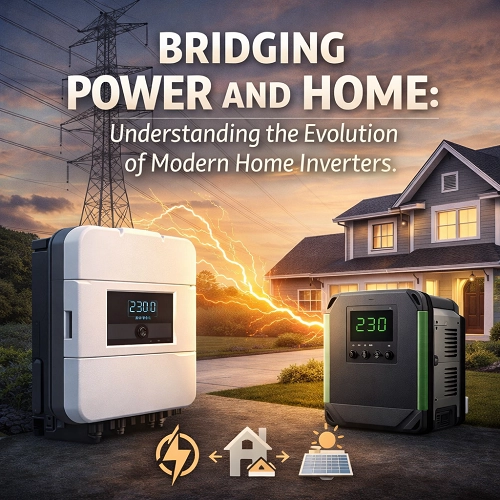
From Voltage to Viability: The Inverter's Role in Modern Homes
Figure 1: Energy Flow in a Modern Home Inverter System - From Solar Generation to Household Consumption
The residential energy landscape has transformed dramatically over the past decade. Where households once relied exclusively on centralized grid power, the proliferation of rooftop solar installations and home battery systems has created a new paradigm: distributed generation and storage. At the heart of this transformation stands a humble but indispensable device—the home inverter.
A home inverter serves as the critical bridge between renewable energy sources and household appliances. Solar panels generate direct current (DC), a form of electrical flow incompatible with standard AC appliances that power everything from your refrigerator to your heating system. Without an inverter, that precious solar energy would be utterly inaccessible.
According to industry leaders like Sunohoo Technology's household energy storage solutions, modern inverters have evolved beyond simple voltage converters. They now function as intelligent energy management systems, making split-second decisions about power routing, load balancing, and grid interaction. This sophistication has made home renewable energy systems viable not just for early adopters, but for mainstream consumers seeking energy independence and cost savings.
The Core Science: DC-to-AC Conversion Explained
Figure 2: The Fundamental Transformation - From Constant DC to Oscillating AC Power
To understand how a home inverter works, we must first grasp the essential difference between direct current and alternating current.
Understanding DC vs AC
Direct Current (DC) flows in one direction at constant voltage. A solar panel produces DC—electrons moving from the negative to the positive terminal at a steady rate. While stable and efficient for storage in batteries, DC cannot power standard household appliances, which are engineered for alternating current.
Alternating Current (AC) oscillates back and forth, changing direction many times per second. In North America, this happens 60 times per second (60 Hz); in Europe and Asia, 50 times per second (50 Hz). This oscillation is not arbitrary—it's fundamental to how transformers, motors, and countless appliances operate.
The Inversion Process
A home inverter accomplishes the DC-to-AC conversion through a process called pulse-width modulation (PWM) or more advanced techniques. At its core, the inverter uses electronic switches (typically high-power MOSFETs or IGBTs) to rapidly connect and disconnect the DC source. By varying the duration of these connections—the "pulse width"—the inverter synthesizes a waveform that approximates a pure sine wave.
Modern inverters produce what's called a pure sine wave output, which closely mimics the smooth oscillation of grid electricity. This is crucial because sensitive electronics like computers, televisions, and medical equipment require this pure waveform. Cheaper inverters may produce a stepped or square wave approximation, which can damage sensitive devices and is increasingly obsolete.
- Input Voltage: 12V, 24V, 48V, or 96V DC (depending on system design)
- Output Voltage: 120V, 240V single-phase, or 208V, 277V, 480V three-phase AC
- Frequency Accuracy: ±0.5 Hz to maintain grid synchronization
- Conversion Efficiency: 95-98% for quality units (losses manifest as heat)
- Response Time: Microseconds to adjust output in response to load changes
Taxonomy of Home Inverters: Which Fits Your Energy Profile
Not all home inverters are created equal. The inverter market has diversified to serve different energy scenarios, from simple backup power to complete energy independence.
1. Grid-Tied Inverters (Grid-Connected)
Grid-tied inverters are the most common type installed in residential solar systems today. These devices synchronize solar power directly with grid electricity, allowing excess generation to be exported to the utility network (and credited through net metering programs).
- Primary Function: Convert solar DC to AC that matches grid voltage and frequency
- Grid Dependency: Requires grid connection; shuts down during outages for safety
- Efficiency: Highest efficiency ratings (96-98%) due to simplified operation
- Cost: Most affordable option (typically $0.50-$0.80 per watt)
- Best For: Homeowners with reliable grid access seeking maximum financial returns
2. Off-Grid Inverters
Off-grid inverters operate independently from utility power, working exclusively with battery storage systems. They manage the complex relationship between solar generation, battery charge state, and household load demands.
- Primary Function: Supply AC power from batteries during demand; manage charging during solar generation
- Grid Dependency: Zero dependence; system autonomy requires careful load management
- Complexity: Higher—must prevent over-discharging batteries and manage voltage regulation
- Cost: Higher upfront cost due to battery system requirements
- Best For: Remote locations, backup power prioritization, complete energy independence
3. Hybrid Inverters (Bidirectional)
Hybrid inverters represent the pinnacle of residential inverter technology. These intelligent systems seamlessly integrate solar generation, battery storage, and grid connection, optimizing energy flow for maximum self-consumption and resilience.
- Primary Function: Coordinate solar, battery, and grid in real-time for optimal efficiency
- Bidirectional Power Flow: Can both supply and draw power from the grid
- Advanced Features: Load prioritization, time-of-use optimization, seamless backup
- Cost: Premium pricing ($1.00-$1.50 per watt) but long-term ROI through arbitrage
- Best For: Forward-thinking homeowners wanting maximum energy flexibility and resilience
Hybrid Systems: The Bridge Between Grid and Independence
Figure 3: Hybrid Inverter Operating Modes - Seamless Transitions Across Energy States
Hybrid inverters represent the frontier of residential energy management. Unlike their simpler counterparts, these systems make intelligent, real-time decisions about energy routing—decisions that can save homeowners thousands of dollars annually.
The Three Operating Modes
Solar Abundance Mode: When solar generation exceeds household demand and the battery is sufficiently charged, the hybrid inverter exports excess power to the grid. This happens transparently, requiring no homeowner intervention. The system continuously balances three competing priorities: powering immediate loads, charging the battery, and feeding power to the grid.
Load-Shifting Mode: During peak utility rates, the hybrid inverter draws power from the battery rather than from expensive grid power. Time-of-use (TOU) rate structures are increasingly common, with peak rates during 2-9 PM and cheaper rates during midnight-6 AM. An intelligent hybrid system learns these patterns and pre-charges batteries during cheap hours, automatically shifting consumption patterns to save money.
Backup Mode: When grid power fails, a properly configured hybrid system provides uninterrupted AC power to critical loads. This transition occurs in milliseconds—faster than the human eye can perceive. Unlike simple battery backup systems, true hybrid inverters accomplish this without disrupting sensitive devices.
Technical Specifications That Matter
When comparing home inverters, several technical parameters deserve serious attention. These specifications determine performance under real-world conditions.
| Specification | Importance | What to Look For |
|---|---|---|
| Continuous Power Rating (kW) | Critical | Must exceed average home consumption; typically 3-10 kW for residential applications |
| Surge Capacity | Very High | Must handle 2-3x continuous rating for motor startup; air conditioners can demand 20 kW briefly |
| Efficiency | High | Look for ≥95% at rated load; impacts annual energy losses (1-5% depending on system design) |
| Total Harmonic Distortion (THD) | High | Lower is better; <5% is excellent, avoiding equipment damage and ensuring compatibility |
| DC Input Voltage Range | Medium | Wider range (e.g., 350-800V) accommodates more solar array configurations |
| Maximum PV Input Current | High | Must match solar array capacity without curtailment; prevents leaving power on the table |
| Cooling Method | Medium | Passive cooling more reliable than active fans; essential in hot climates where failures are costly |
| Communication Interfaces | Medium | WiFi, RS485, or Ethernet for monitoring and firmware updates; critical for troubleshooting |
Understanding Power Ratings
Home appliances have varying power demands. A 10 kW inverter seems large until you consider that an air conditioner compressor might momentarily demand 8 kW, leaving only 2 kW for other loads. Professional installers size inverters with headroom to handle simultaneous loads plus future expansion.
- Refrigerator: 600W continuous
- Electric heating system: 5,000-10,000W
- Air conditioning: 5,000-8,000W (compressor), 2,000W (fan)
- Electric water heater: 4,000-5,500W
- Induction cooktop: 3,000-5,000W per burner
- Whole-home continuous average: 1,000-2,000W
Navigating Common Technical Problems
Even quality home inverters occasionally encounter issues. Understanding common problems and their solutions prevents unnecessary replacement costs and service calls.
Problem 1: Inverter Startup Failure
The inverter won't turn on or repeatedly powers off during startup.
Common Causes:
- Low DC voltage from solar panels or battery (below minimum operating threshold)
- Poor battery terminal connections causing voltage drop
- Battery cell imbalance in larger installations
- Tripped AC breaker or disconnected grid connection
- Firmware corruption or need for software reset
Solutions: Check all DC connections for corrosion or looseness. Measure voltage at battery terminals directly (not at the breaker). For persistent issues, perform a full system reset: disconnect both AC and DC sources for 30 seconds, then reconnect in reverse order. Modern systems like those from Sunohoo Technology include built-in diagnostics—consult the error codes displayed on the inverter's LCD panel.
Problem 2: Low Output Power Under Clear Skies
The inverter operates but produces significantly less power than expected during peak solar conditions.
Common Causes:
- Partial shading on solar panels (even small shadows reduce output dramatically)
- Dust or pollen accumulation on panel surfaces
- MPPT (Maximum Power Point Tracking) controller not in optimal configuration
- Temperature derating—inverters reduce output as internal temperature rises
- String imbalance if multiple solar strings are connected in parallel
Solutions: Inspect panels for obstructions and clean with soft water and a non-abrasive cloth. Check for reflections from nearby surfaces that cause localized heating. In the inverter settings, verify MPPT scan frequency and response time settings. Some units ship with conservative tuning; aggressive MPPT settings can coax 2-3% additional power from marginal conditions.
Problem 3: Battery Not Charging Despite Sunlight
Solar panels receive adequate sunlight, but the battery remains discharged.
Common Causes:
- Battery already fully charged (check state-of-charge display)
- Charge controller configured with insufficient charging setpoint
- Faulty battery communication or battery management system error
- Ground-fault condition preventing charging
- Undersized solar array relative to battery capacity
Solutions: Verify battery voltage and state-of-charge through the inverter's monitoring interface. Check charging parameters in system settings—some configurations deliberately minimize charging to extend battery lifespan. For persistent issues, disconnect the battery and measure voltage directly; a battery showing 0V is likely damaged. Recent innovations in lithium battery systems include built-in cell-balancing circuits that can recover seemingly "dead" batteries.
Problem 4: Inverter Overheating and Derate
Inverter power output reduces progressively on hot days or during extended operation.
Common Causes:
- Inadequate ventilation or mounting in direct sunlight
- Dust clogging cooling fins or passive heatsinks
- Ambient temperature exceeding design specifications
- Continuous high-power operation (designing for 100% duty cycle is unrealistic)
Solutions: Ensure minimum 6 inches of clearance around the inverter for air circulation. Install in shade or use a reflective cover to reduce solar gain. Clean cooler fins with compressed air quarterly. If overheating persists, consider a larger unit designed for your climate's peak temperatures. Hybrid inverters from manufacturers like Sunohoo's all-in-one energy storage solutions include advanced thermal management to minimize derating.
MPPT vs PWM: Efficiency at the Heart
Figure 4: MPPT vs PWM Comparison - The Efficiency Difference Compounds Over Years
One of the most consequential design choices in solar systems involves charge controllers: PWM or MPPT. For homeowners, this decision directly impacts annual energy production by 25-30%—a gap that compounds substantially over system lifespan.
PWM: Simple but Limited
Pulse-Width Modulation controllers work by rapidly switching the solar array's output on and off. While crude, this approach is remarkably effective when solar voltage naturally matches battery voltage. PWM controllers are inexpensive ($100-300) and require minimal configuration, making them ideal for small off-grid cabins or emergency backup systems.
However, PWM has a critical limitation: it forces solar panels to operate at battery voltage rather than their optimal power point. A solar array at 48V (to match battery voltage) might naturally operate most efficiently at 350V with a different current. PWM ignores this mismatch, leaving energy on the table.
MPPT: Intelligent Harvesting
Maximum Power Point Tracking controllers employ sophisticated algorithms to dynamically adjust the relationship between panel voltage and current. Internally, they use a high-frequency transformer to accomplish this voltage conversion, achieving theoretical efficiency near 99%.
MPPT controllers constantly sample the solar array's voltage and current, calculating instantaneous power. They then adjust their internal switching frequency microsecond-by-microsecond to maintain operation at the peak of the power curve. This sophistication costs more ($400-1500), but the energy gains quickly repay the investment.
Modern hybrid inverters universally employ MPPT technology because the incremental cost is trivial when amortized over the system's lifespan. The decision to use MPPT versus PWM primarily affects older systems or specialized applications like RV solar or emergency backup where cost minimization overrides efficiency.
Choosing Your Home Inverter
Selecting the right inverter requires balancing technical specifications against practical constraints and future aspirations.
Step 1: Define Your Energy Goals
Ask yourself: Do I want to eliminate grid dependency, reduce electricity bills, provide backup power during outages, or maximize solar self-consumption? Your answer determines inverter type.
- Grid-connected with no backup: Choose a simple grid-tied inverter (most cost-effective)
- Grid-connected with battery backup: Select a hybrid inverter
- Complete energy independence: Plan for off-grid or hybrid with large battery (15+ kWh)
Step 2: Calculate System Capacity
Review 12 months of electricity bills to determine average consumption. Add 20% headroom for future electric vehicle charging or home electrification (replacing gas appliances). This total is your minimum inverter capacity.
For solar array sizing, professional installers use your location's solar irradiance data to design systems that generate 110-120% of annual consumption, accounting for seasonal variation and system losses. A properly sized system achieves 80%+ self-consumption in favorable climates.
Step 3: Evaluate Manufacturer Support
Inverter technology is complex, and support quality varies dramatically. When comparing brands, investigate:
- Warranty period (10+ years is standard; 25+ is excellent)
- Local service network for repairs
- Online monitoring and diagnostic tools
- Firmware update frequency and responsiveness to issues
- Technical documentation quality and community forums
Sunohoo Technology, as a subsidiary of Zhejiang SUNOREN Solar (Stock Code: 603105), represents the caliber of manufacturer that understands both the technical and commercial aspects of residential energy storage. Their approach to portable power station products alongside fixed home systems demonstrates comprehensive energy solutions thinking.
Step 4: Consider Future Expansion
Purchase an inverter with headroom for future expansion. A 5 kW inverter today might support battery addition in two years. Some inverters permit stacking or firmware updates that unlock additional capacity. These design choices reflect manufacturer vision and positively impact long-term value.
The Future of Residential Inverter Technology
The inverter industry is experiencing rapid innovation, driven by declining battery costs and increasing grid complexity. Several trends are reshaping what homeowners can expect from their energy systems.
AI-Driven Optimization
Next-generation inverters will employ machine learning algorithms that learn household consumption patterns, weather forecasting, and utility rate structures. These systems will autonomously optimize charging and discharging to minimize electricity costs while maintaining battery health—all without human intervention.
Grid Services and Demand Response
Battery-equipped homes increasingly provide valuable services to utilities: voltage support, frequency regulation, and peak demand reduction. Utilities are beginning to compensate homeowners for these grid services. Future inverters will seamlessly participate in these markets, translating to additional revenue streams.
Vehicle Integration
As electric vehicles proliferate, the smart home inverter becomes a vehicle charging controller, energy router, and emergency backup source. Bidirectional chargers already enable vehicle-to-home (V2H) power transfer, transforming an EV's 60 kWh battery into a distributed energy resource. This integration will mature from novelty to standard feature within five years.
Enhanced Cybersecurity
As inverters gain internet connectivity and control over critical loads, security becomes paramount. Future systems will employ military-grade encryption, secure software updates, and isolated operation modes that permit offline functionality even if internet connectivity fails. This maturation will address legitimate concerns from grid operators about connected devices.
Conclusion: Your Energy Future Begins with the Right Inverter
The home inverter, once a boring utility device, has evolved into a sophisticated energy intelligence center. Whether you're protecting yourself against grid unreliability, optimizing your solar investment, or pursuing complete energy independence, choosing the right inverter shapes your renewable energy success.
The technical details matter: MPPT efficiency, THD specifications, and thermal management directly impact performance. Yet equally important is partnering with manufacturers who understand both the technology and your long-term energy aspirations. Companies like Sunohoo Technology, which offer comprehensive solutions across household energy storage and portable power systems, demonstrate the depth of expertise necessary for reliable, long-term solutions.
As you plan your renewable energy journey, invest time in understanding your inverter's capabilities and limitations. This knowledge will compound through decades of reliable, efficient operation—transforming your home into a node in the distributed energy future while providing the peace of mind that comes from energy independence.
The inverter that powers your home today is also building the grid of tomorrow.